Erythronium
dens-canis (Dog's-tooth Violet)
“A woodland jewel. Swept-back pink flowers and beautifully mottled leaves in dappled shade in March. Slow to establish, long-lived, and one of the most refined spring flowers you can grow.”
— ROSIE
Rosie's Take
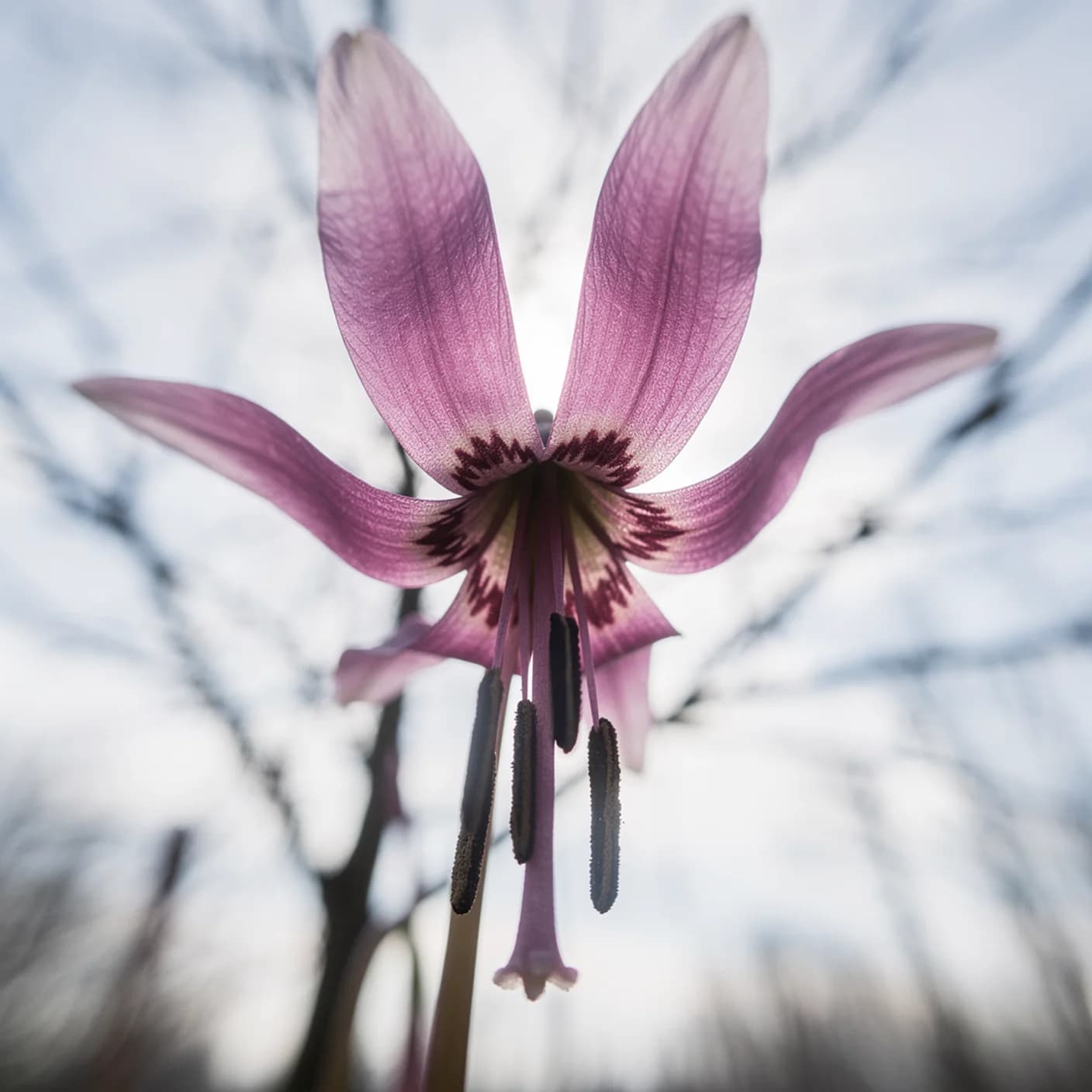
Erythronium dens-canis is one of those flowers that makes you get down on your hands and knees. You have to. It's only six inches tall, and the detail is too good to see from standing height. Each flower is a single, nodding stem carrying a solitary bloom with swept-back petals — reflexed, like a miniature Turk's cap lily — in soft pink-purple with a ring of darker markings at the base. The petals curve upwards and backwards so completely that they almost touch behind the flower, giving it a windswept, dynamic look, as if it's been caught mid-movement.
The leaves are as beautiful as the flowers — a pair of broad, tongue-shaped, dark-green leaves mottled with chocolate-brown and maroon markings, like the patterns on a thrush's egg. They lie flat against the ground, framing the flower stem, and are worth growing for alone. In a woodland garden, the combination of those marbled leaves and those reflexed pink flowers in March and April is one of the most refined things the spring garden offers.
The common name 'dog's-tooth violet' comes from the shape of the bulb — elongated, pointed, white, and fang-like. It's not a violet at all, of course, but a lily relative. The bulbs hate being dried out, which is why you should buy them 'in the green' if you can, or at least plant them immediately after purchase. Tuck them into humus-rich soil in dappled shade — under shrubs, beneath a hedge, at the base of a north-facing wall — and leave them undisturbed.
They're slow to establish but long-lived, and once settled they'll self-seed gently into small colonies. I've had the same patch under a hazel for seven years now, and each March a few more appear than the year before. Patience with erythronium is always rewarded. It's a connoisseur's flower, but it shouldn't be — it's easy enough for anyone with a shady corner and a willingness to wait.
Where to Buy
If you want to try erythronium for yourself, here's where I'd point you:
We may earn a small commission from purchases made through our links, at no extra cost to you.
✿ From the folklore cabinet
Erythronium dens-canis is the only species in the genus native to Europe — it grows wild across southern and central Europe, from Portugal to Ukraine, in mountain meadows and open woodland. The 'dens-canis' means 'dog's tooth,' describing the shape of the bulb. John Gerard, the Elizabethan herbalist, grew it in his London garden in the 1590s and illustrated it in his Herball. In parts of Europe, particularly the Alps and Pyrenees, it carpets mountain meadows in spring with enough density to colour entire slopes pink. I've only seen photographs of those wild colonies, but they're on my list. The Victorians called it the 'European trout lily,' comparing the leaf markings to the spots on a brown trout. I think the thrush's egg comparison is closer, but I understand the impulse to match this plant with something equally beautiful.