Passion Flower
Passiflora caerulea
“The most structurally extraordinary flower you'll find on a British wall. Delivery drivers stop and stare. So will you.”
— ROSIE
Rosie's Take
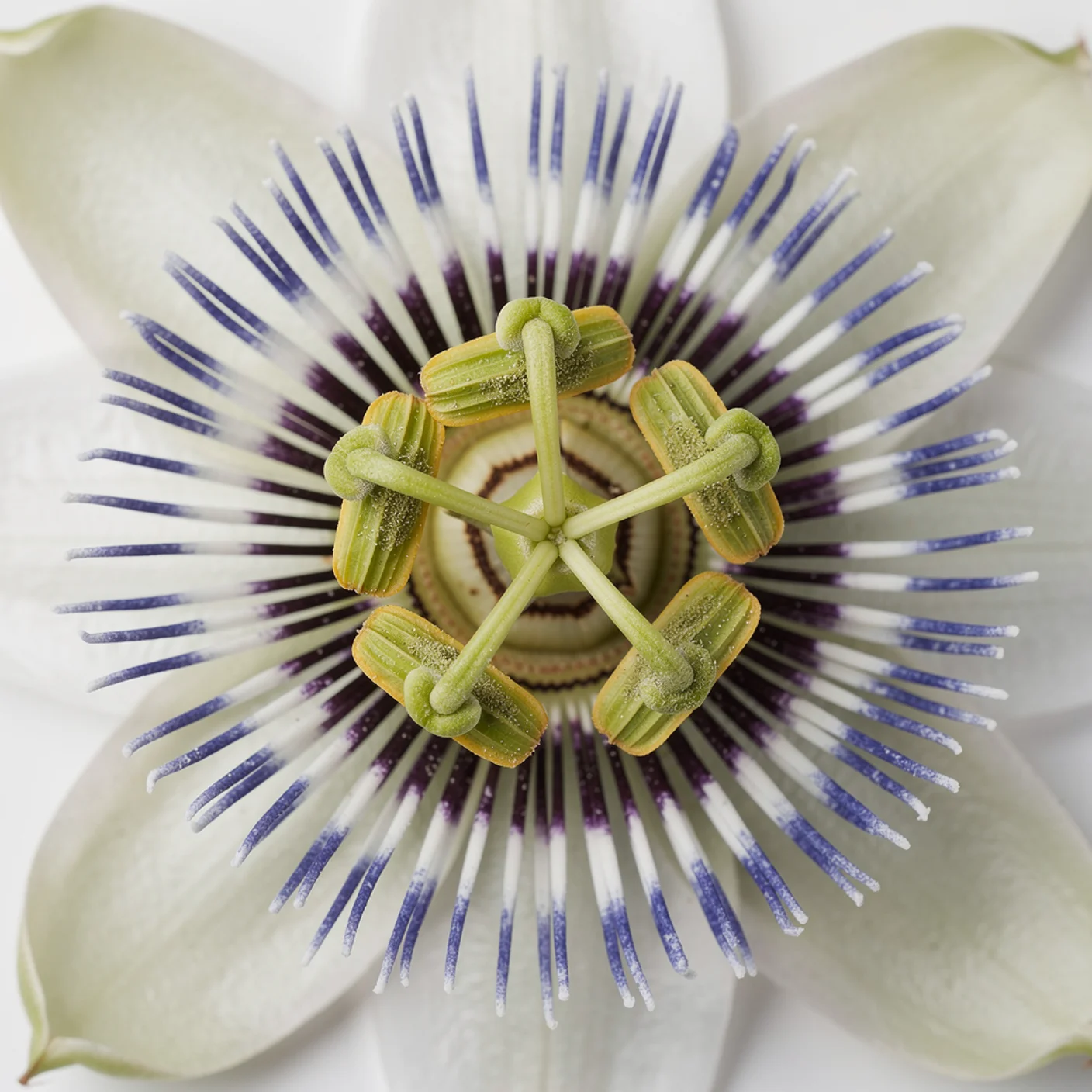
The first time I saw a passion flower up close I genuinely couldn't believe it was real. That intricate corona of purple and white filaments radiating from the centre, the five stamens, the three-armed pistil, the ten tepals arranged around the outside — it looks like something a jeweller designed after a particularly vivid dream. It's the most structurally complex flower you'll find growing on a British wall.
Passiflora caerulea is the hardy one, the species that survives British winters if you give it a warm, sheltered wall. Once established, it's vigorous — enthusiastically so — covering a fence or trellis with dark, glossy, hand-shaped leaves and producing those extraordinary flowers from July to October. Each bloom lasts only a day or two, but the plant produces so many in succession that there's always something open.
The flowers are about four inches across and they stop people. I've had delivery drivers pause on the doorstep to ask what it is. The white outer petals form a flat platform, and the corona of filaments — banded blue, white, and purple — creates a frilled halo that catches the light. In the centre, the reproductive parts are arranged with a precision that borders on architectural. It's wildly, improbably beautiful.
In autumn, if the summer was warm enough, you get egg-shaped orange fruits that are technically edible but not really worth eating — tough and seedy, nothing like the commercial passion fruit. I leave them on the vine for their colour. The whole plant, flower and fruit and leaf, has a tropical exuberance that feels like it shouldn't work in an English garden. But it does. Brilliantly.
Where to Buy
If you want to try passion flower for yourself, here's where I'd point you:
We may earn a small commission from purchases made through our links, at no extra cost to you.
✿ From the folklore cabinet
The 'passion' in passion flower isn't romantic — it refers to the Passion of Christ. Spanish missionaries in South America saw Christian symbolism in every part of the flower: the ten tepals represent the ten faithful apostles, the corona represents the crown of thorns, the five stamens are the five wounds, and the three styles are the three nails. It's an extraordinary piece of theological botanical interpretation, and whether or not you're religious, you have to admire the imaginative commitment. The name has stuck for five hundred years.