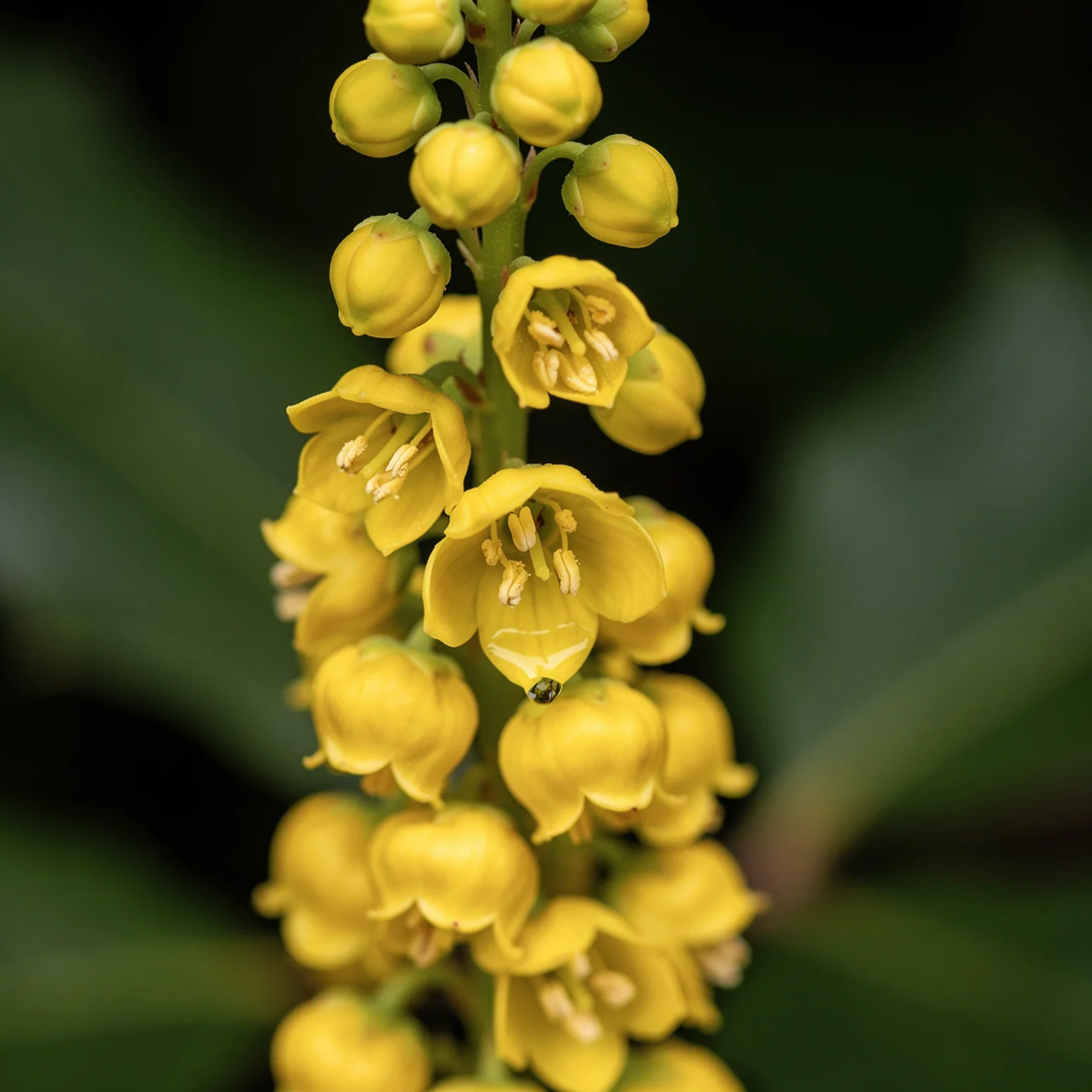
Mahonia
Charity
“The winter garden's most unlikely pleasure. 'Charity' blooms from November to February with a scent that has no business being that good in the darkest months.”
— ROSIE
Rosie's Take
Mahonia 'Charity' is the plant I'd prescribe for anyone who thinks gardens are only worth looking at in summer. From November to February — the very deepest, greyest months — it produces these long, upright sprays of bright yellow flowers that smell unmistakably of lily of the valley. In January. Outside. It's almost rude, how good it is.
The plant itself is architectural to the point of being slightly aggressive. Those long, pinnate, holly-like leaves are spiny and arranged in whorls, creating a structural silhouette that looks good even when not in flower. It's not a plant you brush past casually — it'll remind you it's there. But in winter, when those candelabra-like flower clusters appear at the tips, the combination of fierce foliage and gentle, scented flowers is unexpectedly beautiful.
The scent is the real revelation. Warm, sweet, distinctly reminiscent of lily of the valley but with a sharper, more citrus edge. On a mild winter day, you can catch it from several feet away. On a cold one, you have to lean in, and the warmth of your breath releases it. Either way, it stops you. Finding a scent that good in the middle of January is like finding a fire burning in an empty room.
Bees love it, which is critical — in winter, there's very little else for early pollinators. I've seen bumblebees working the flowers on Boxing Day, which should be impossible but apparently isn't. 'Charity' quietly keeps the garden alive when everything else has given up.
Where to Buy
If you want to try mahonia for yourself, here's where I'd point you:
We may earn a small commission from purchases made through our links, at no extra cost to you.
✿ From the folklore cabinet
Mahonia is named after Bernard M'Mahon, an Irish-American horticulturist who received plant specimens from the Lewis and Clark expedition. 'Charity' was raised at the Savill Garden in Windsor Great Park in the 1950s — a cross between M. japonica and M. lomariifolia that combined the best scent of one parent with the architectural flower sprays of the other. The berries that follow the flowers are technically edible — tart, sour, and used to make a kind of rough jelly in some traditions — though I've never been tempted enough to try.