Protea
King
“The most architectural flower you can buy. One stem lasts for weeks, dries for months, and earns its place in any room that needs something quietly extraordinary.”
— ROSIE
Rosie's Take
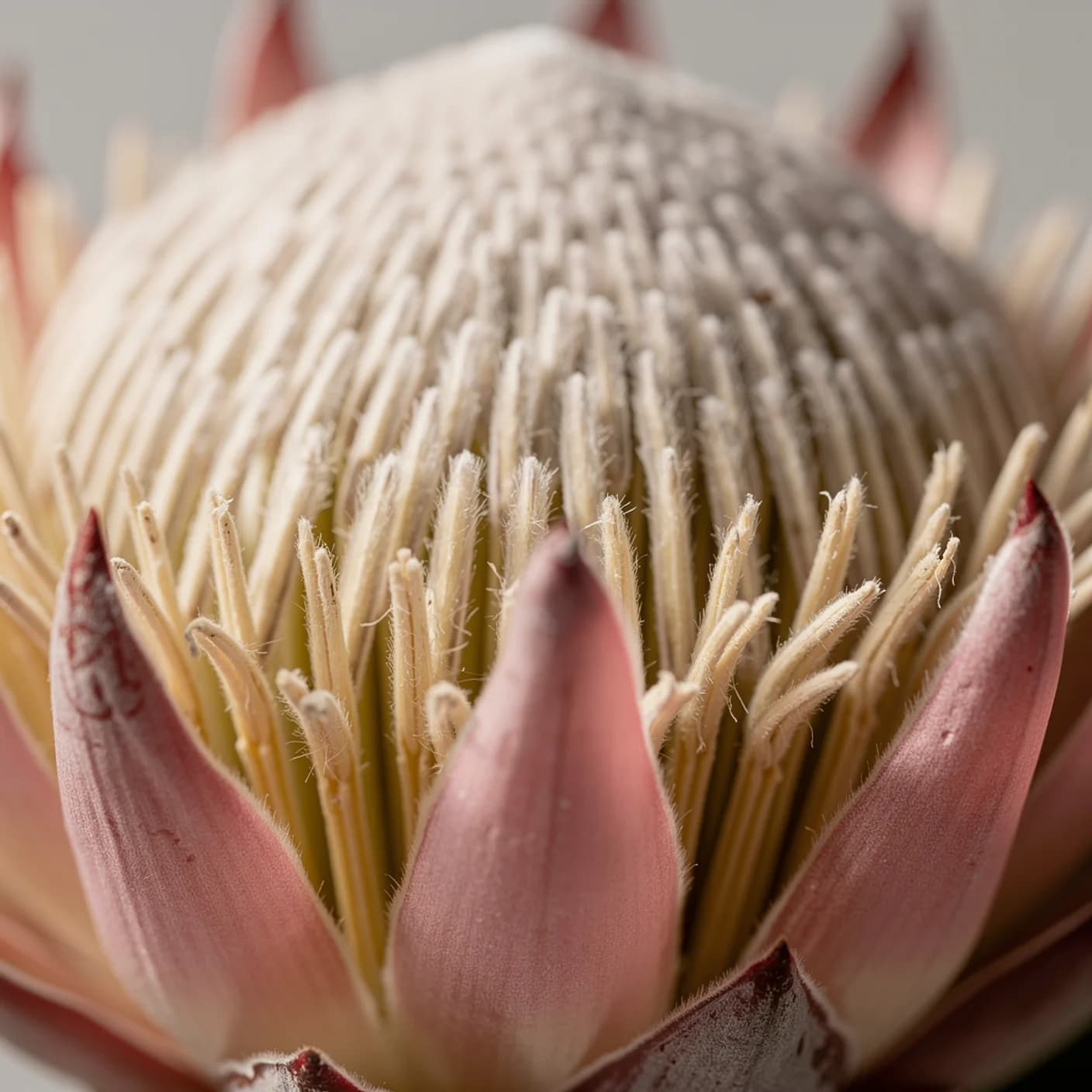
I know protea is a departure from my usual territory. It's not British, it's not cottage garden, and it certainly isn't something you'd find in a hedgerow. But I first encountered a King Protea at a specialist florist one bleak January, and I stood in front of it for a full minute because I couldn't work out how something that looked like it was carved from leather and wax could be a real flower.
Protea cynaroides is the national flower of South Africa, and it's unlike anything else you'll find in a florist. Those huge, bowl-shaped flower heads — easily the size of a side plate — with their pointed, waxy bracts arranged in concentric circles around a dense, furry centre. The texture is extraordinary. Part artichoke, part alien, part something from a medieval manuscript.
They last for weeks as a cut flower. Weeks. And they dry magnificently — the form holds, the colour fades to a gorgeous warm taupe, and you've got something architectural on your mantlepiece for months afterwards. The value for money, when you think about it that way, is actually rather good.
I wouldn't put protea in a cottage garden vase. It needs something simple and strong — a plain ceramic pot, a wide glass vessel — and it needs to be alone or with very minimal company. One stem, one vessel, and stand back. It's not a flower that needs help.
Where to Buy
If you want to try protea for yourself, here's where I'd point you:
“The Blossomist carry King Protea year-round and their stems are properly impressive — the kind of single flower that replaces a whole arrangement.”
Order This Flower →We may earn a small commission from purchases made through our links, at no extra cost to you.
✿ From the folklore cabinet
Protea is named after Proteus, the Greek god who could change his shape — a reference to the extraordinary diversity of forms within the genus. King Protea has been South Africa's national flower since 1976 and appears on their currency. It's one of the oldest flowering plant families on earth, dating back around 300 million years. My January arrangement felt appropriately ancient.