Field Poppy
Papaver rhoeas (Common Poppy)
“Britain's most emotionally powerful wildflower. Silk-thin scarlet petals, a day or two of perfection, and the knowledge that the seeds have been waiting in the soil for a hundred years. Untameable.”
— ROSIE
Rosie's Take
The field poppy is the most emotionally loaded wildflower in Britain. That tissue-paper red — fragile, crumpled, impossibly vivid — against a June cornfield or a stretch of bare roadside earth. It's the flower of remembrance, of Flanders, of November silence. But before all that, it's simply one of the most arresting wild plants you'll ever see, and the fact that it grows uninvited, in disturbed ground, from seed that can lie dormant for decades, makes it more remarkable, not less.
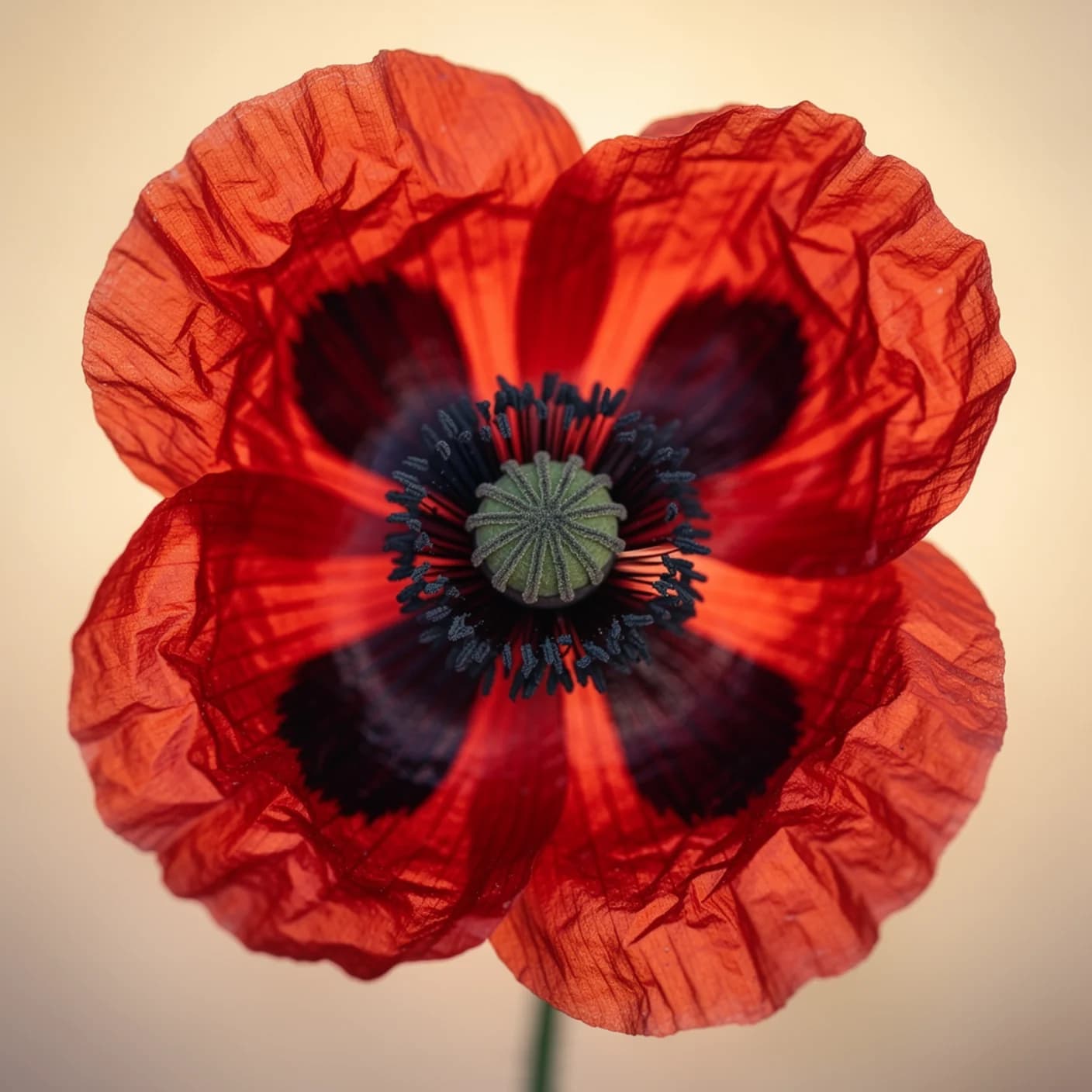
Each flower lasts a day or two at most. The buds are hairy and nodding, hanging their heads like shy things, and then they crack open and these impossibly crumpled petals unfurl — four silk-thin, overlapping, scarlet petals with a black blotch at the base surrounding a dark central disc. The red is not just red. It's that particular poppy-red — warm, slightly orange, translucent when backlit, and utterly unlike any cultivated flower. Bred roses and dahlias can't touch it.
I love them most at the edges of things — the margins of a wheat field, a recently cleared building site, the verge of a new road. They're pioneer plants, opportunists of bare soil, and they appear with a reliability that borders on the magical. The seed bank in any piece of British agricultural soil contains poppy seeds that might be a hundred years old, waiting for the earth to be turned. When it is, they come back. They always come back.
You can grow them in a garden, of course — scatter seed on bare soil in autumn and they'll flower the following June. But they're never quite as good in a border as they are in a cornfield. Some flowers belong to the landscape, not the garden, and the field poppy is one of them. I'd rather drive past a roadside drift of poppies and feel that catch in my chest than have them tamed in a raised bed.
✿ From the folklore cabinet
The field poppy has been associated with sleep and death since antiquity — the Greek god Hypnos was depicted scattering poppies, and the Romans associated them with Ceres, goddess of the harvest. The First World War connection came from John McCrae's poem 'In Flanders Fields,' written in 1915. Poppies appeared in the churned earth of the battlefields because the disturbance of the soil triggered germination of long-dormant seeds. The same phenomenon happens on any turned ground — building sites, ploughed fields, archaeological digs. It's a flower that responds to upheaval, which gives its association with remembrance a deeper resonance than most people realise.