Climbing Hydrangea
Hydrangea petiolaris
“The shade-wall miracle. Climbing hydrangea turns your worst aspect into a four-season feature. Just give it three years of patience first.”
— ROSIE
Rosie's Take
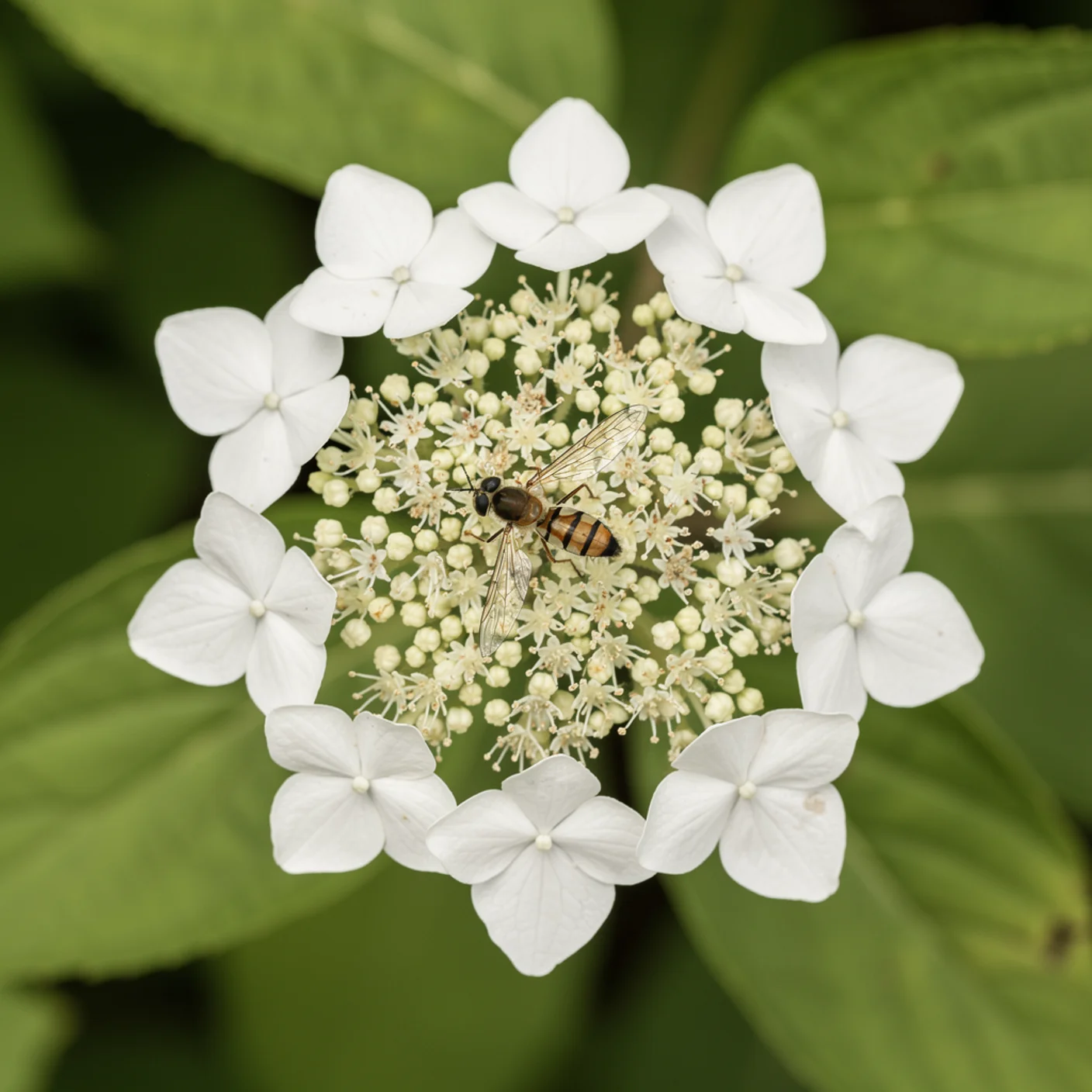
If you have a north-facing wall and you've given up on it, climbing hydrangea is the answer. Hydrangea petiolaris does something almost no other flowering climber will do — it thrives in full shade, clinging to the wall with aerial roots and covering it in a tapestry of fresh green leaves that turn butter-yellow in autumn. And in June, it produces those gorgeous, lacecap flower heads — flat clusters of tiny fertile flowers surrounded by a ring of larger, white, sterile florets.
The flowers have a delicacy that mophead hydrangeas lack. They sit flat against the wall like white doilies, dozens of them scattered across the green foliage, and the effect is restrained and beautiful — lace on green velvet. The scent is subtle but real — a mild, honeyed sweetness that attracts hoverflies and bees to a wall that usually has nothing for them.
It's slow to establish. Painfully slow, in the first couple of years — the old saying is 'first year sleep, second year creep, third year leap,' and that's about right. Mine did nothing visible for two full years, and I nearly gave up on it. Then in year three it began to move, and by year five it was covering six feet of wall and flowering generously. Patience is required. The gardener's hardest skill.
In winter, the bare stems create an intricate lattice of coppery-brown bark that's beautiful in its own right, especially when frosted. The dried flower heads persist too, adding texture. It's a four-season plant on a surface that most people write off. That's the kind of problem-solving I admire in a plant.
Where to Buy
If you want to try climbing hydrangea for yourself, here's where I'd point you:
We may earn a small commission from purchases made through our links, at no extra cost to you.
✿ From the folklore cabinet
Hydrangea petiolaris is native to the woodlands of Japan, Korea, and Siberia, where it scrambles up tree trunks to reach the light. It was introduced to Western gardens in the 1860s, though it remained a specialist's plant for decades — its slow establishment put people off. The name 'petiolaris' refers to the leaf stalks (petioles), which isn't the plant's most interesting feature. In Japan, the young leaves of a related climbing hydrangea are dried and brewed as a sweet ceremonial tea called 'amacha,' used during the Buddhist festival celebrating Buddha's birthday.