Astrantia
Roma
“She makes every other flower look better. Grow her in part shade and cut armfuls all summer. The flower that taught me to look closer.”
— ROSIE
Rosie's Take
Astrantia is the flower that made me realise I'd been looking at flowers wrong. For years I was drawn to the big, obvious beauties — the peonies, the dahlias, the roses. And then someone put an astrantia in my hand and said look, really look, and I fell down a rabbit hole of papery bracts and tiny, intricate florets that I still haven't climbed out of.
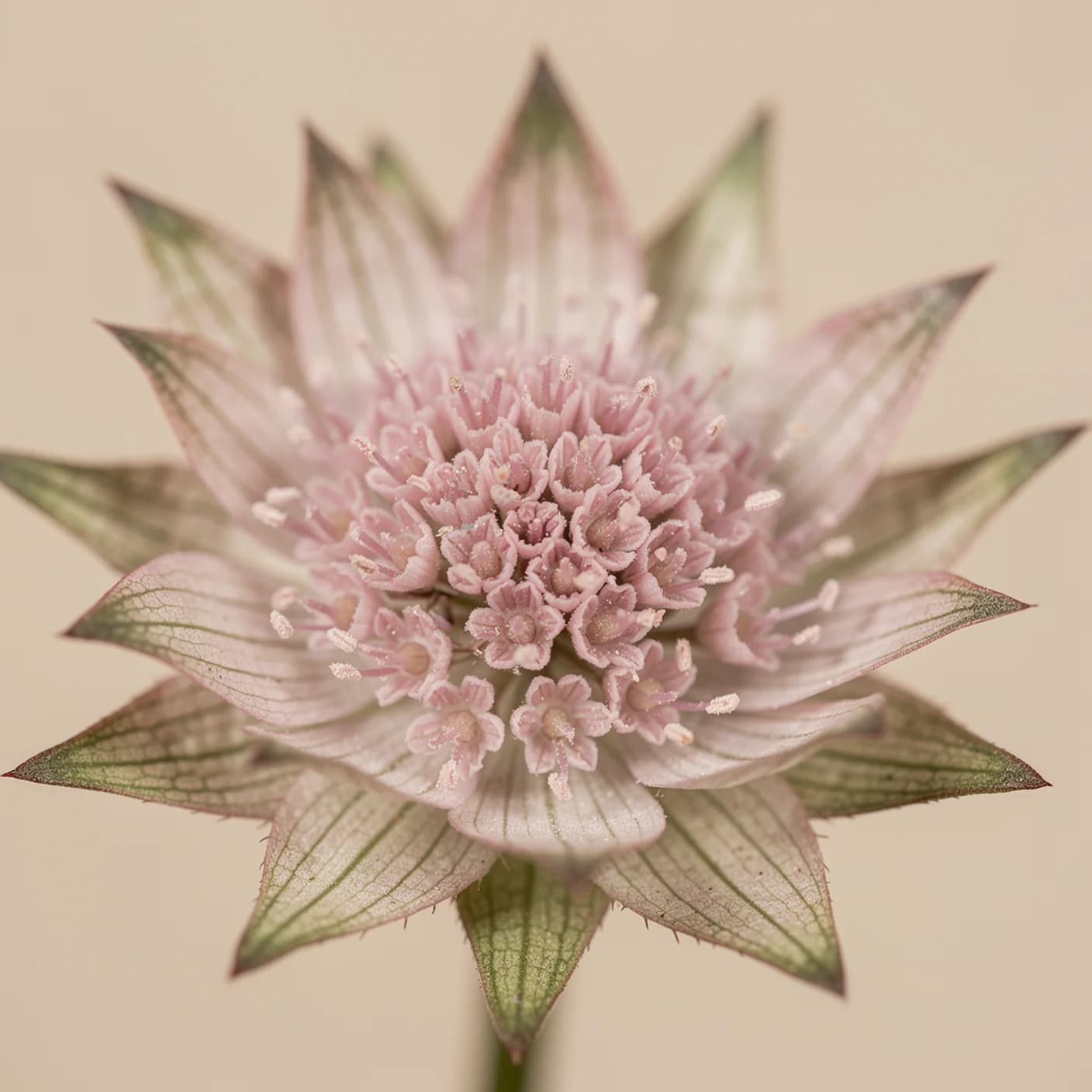
Roma is a soft, dusky pink variety — not the pale greenish-white of the wild type, but a warm, muted rose that looks like it's been painted in watercolours and left to dry slightly. Each flower is actually a dome of tiny florets surrounded by a collar of pointed, papery bracts that have a slight sheen, like tissue paper that someone's ironed. The whole thing is about the size of a fifty-pence piece. It's completely extraordinary.
She flowers from June through to September, which is a serious run for any perennial, and she's perfectly happy in part shade — a rare and valuable quality in a flower this interesting. I grow her under the apple tree where she gets morning sun and afternoon shade, and she's been quietly magnificent for five years.
As a cut flower, astrantia is the florist's not-so-secret weapon. Those papery, structured heads add texture and interest to any bunch without competing with the main flowers. She makes roses look more interesting. She makes peonies look more considered. She's the supporting actress who steals the scene.
She dries perfectly too — the papery bracts hold their shape and colour almost indefinitely. I have dried astrantia on my desk in a small glass that's been there since October. Still beautiful.
Where to Buy
If you want to try astrantia for yourself, here's where I'd point you:
We may earn a small commission from purchases made through our links, at no extra cost to you.
✿ From the folklore cabinet
Astrantia's common name is masterwort — 'master' because medieval herbalists considered it a cure-all. The star-shaped bract pattern gives it another folk name: Hattie's pincushion. I prefer the Latin — astrantia comes from 'aster' meaning star, and when you look at those pointed bracts radiating outward, each flower really is a tiny, perfect star.